
Every buyer asks the same question in a different way. It is not about price and it is not about species. It is: what condition will the tree be in after three weeks at sea?
Here is the whole answer, in the order it happens.
The ball is built, not dug
A tree lifted from a field brings a ball of field soil with it. Ours does not. The roots are cleaned, and the ball is made up again around them.
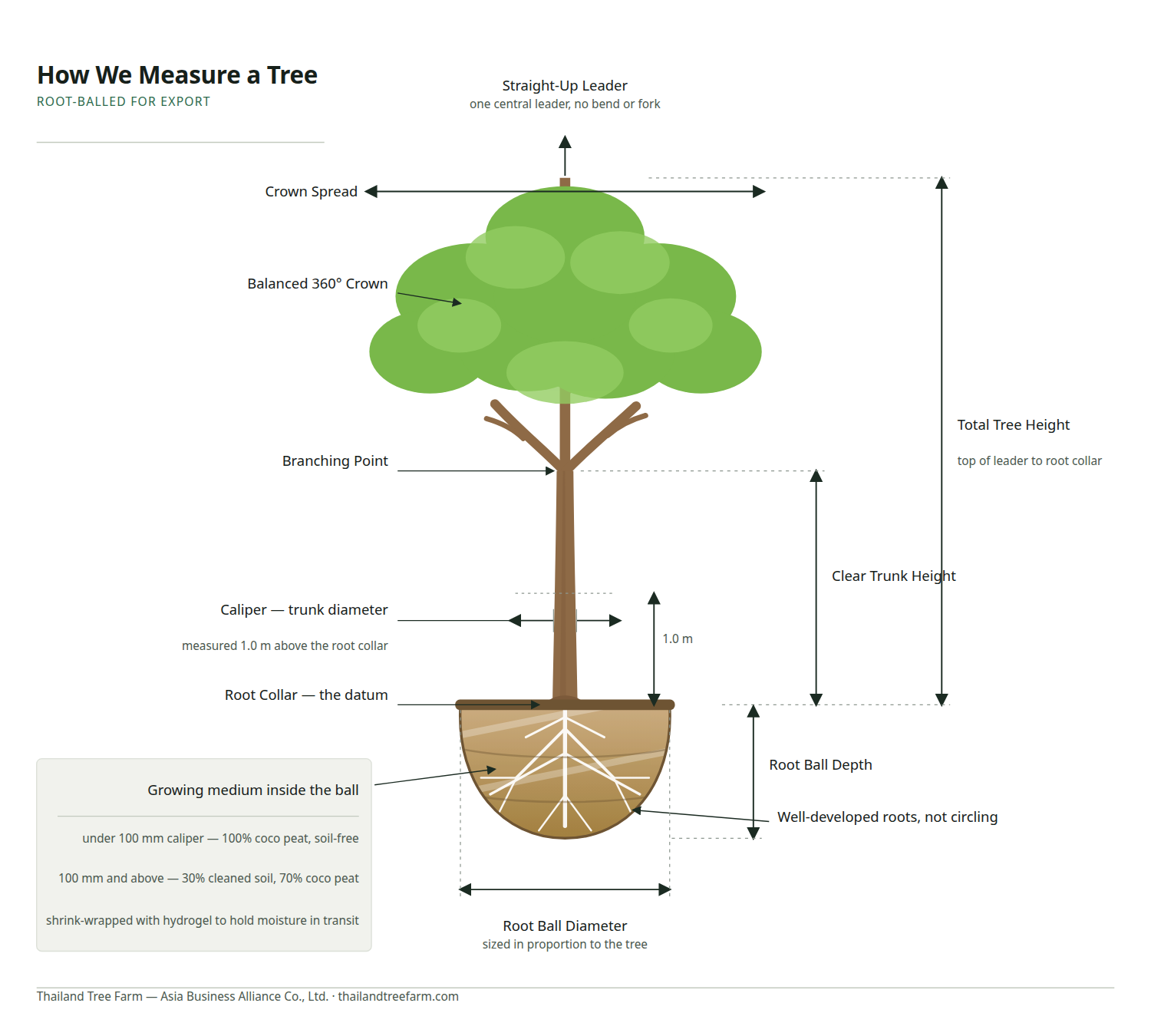
Below 100 mm caliper the ball is 100% coco peat — no field soil at all. At 100 mm and above it is approximately 30% cleaned soil and 70% coco peat, because a ball that size needs the soil fraction to hold together and hold water. Either way the ball is sized in proportion to the tree, and either way it is shrink-wrapped with hydrogel, which keeps moisture at the roots through lifting, loading and the passage.
Where your import authority restricts soil on plant material, tell us at enquiry. Most of what we supply is already soil-free. The Emirates are the strictest market we ship to, and the rules there are set out in full on can you import trees into the UAE with soil on the root ball?
How the ball is wrapped before export
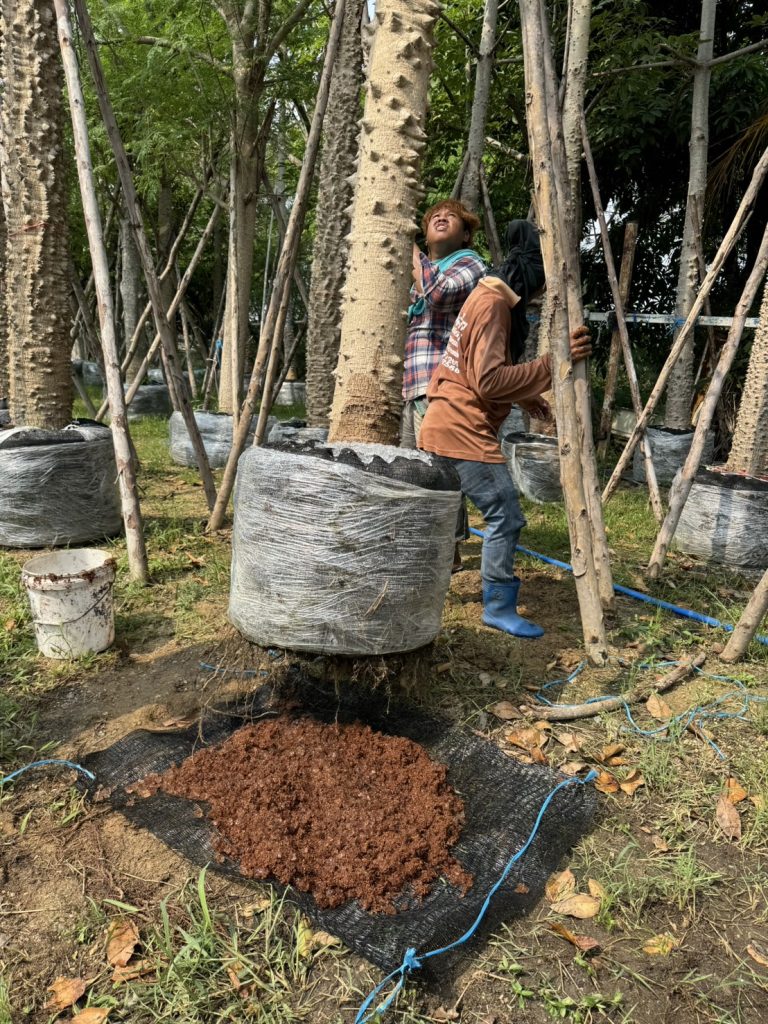
Wrapping happens late, not early. The tree stands in the nursery on its own root system for as long as the programme allows, and the ball is only closed up in the week before it is loaded. That keeps the roots breathing for the months in between instead of sitting sealed in plastic.
When the time comes, the ball is packed with washed coco peat, then drawn in with stretch film worked from the base upwards. The coco peat holds moisture against the fine roots without adding the weight of field soil, and the film keeps that moisture where it belongs for the two to three weeks the tree spends at sea. Because the wrap is continuous, the ball also arrives as one solid mass rather than crumbling in the container.
The same wrap is what lets the ball be lifted by strop rather than by the trunk. Nothing takes the load through the stem, and the tree lands at site with its root plate in the shape it left in.
The container follows the tree
Trees below 100 mm caliper travel in refrigerated containers, where temperature and humidity stay steady the whole voyage. Larger trees will not pass through a container door, so the roof comes off and they are lifted in from above by crane, then laid along the floor with the ball chocked and strapped. Around thirty trees to a 40 ft high-cube, confirmed against the final order because it depends on species and crown form.
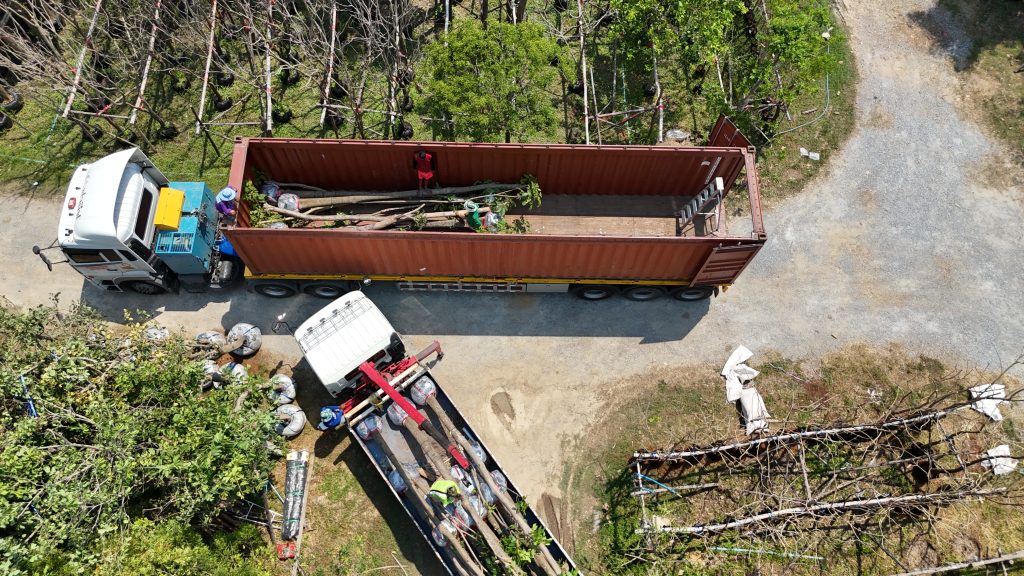
Loading happens at the nursery, not at a depot. The container is trailered in beside the rows it will carry, the roof is opened, and the crane works from the truck alongside — so each tree is lifted once, from the ground to the floor of the box it will sail in. Every extra handling is a chance to damage a ball, and this removes most of them.
In the aerial view above the wrapped balls are staged on the second trailer while the first trees are already laid along the container floor. Trunks are padded where they cross, crowns are tied back, and the balls are chocked and strapped so nothing shifts on the road to Laem Chabang or in the seaway.
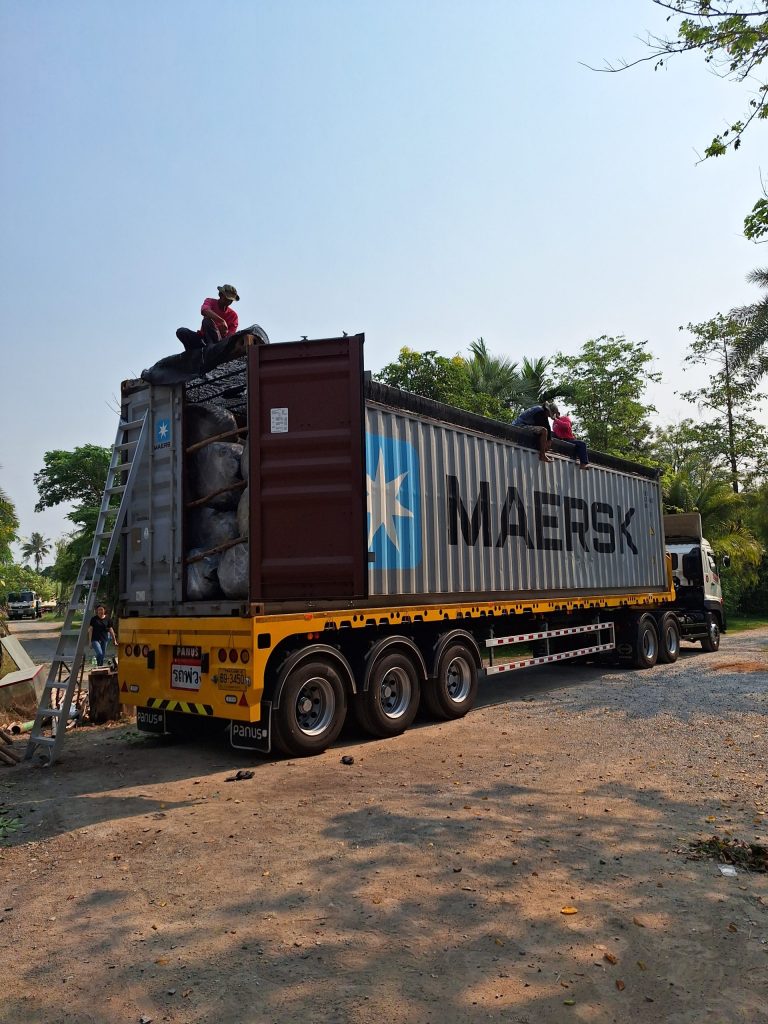
Nothing travels loose. Timber is wedged across the box so the balls cannot roll, the load is packed tight front to back, and the tarpaulin is drawn over the open top and roped down before the trailer moves. The doors are closed and sealed at the nursery, so the container opened at your end is the one we filled.
Built for the passage that goes wrong
Sailings run 14 to 25 days to Gulf ports and 7 to 15 days to Asia. Preparation is rated to hold a tree for up to 45 days — well past any scheduled sailing. That margin is deliberate. When a vessel is delayed or a transhipment is missed, the delay costs time instead of trees.
What travels with the container
Certificate of Origin, phytosanitary certificate carrying the treatment declaration, commercial invoice and packing list. Roots are treated with an approved fungicide and nematicide before packing, and the treatment is endorsed in the phytosanitary certificate. Loading port is Laem Chabang.
How we measure a tree
Every figure we quote is measured from the root collar, in millimetres. This is the same drawing our growers work to.
Before you order
Send the species and grade in millimetres of caliper, the quantity, the destination port, and the week you need the trees on site. If your destination restricts growing medium, say so in the same message. You will get an answer from the people who grow the trees.
WhatsApp +66 82 693 9293 · rfq@thailandtreefarm.com